Zoe Jenkins · 16 November 2026
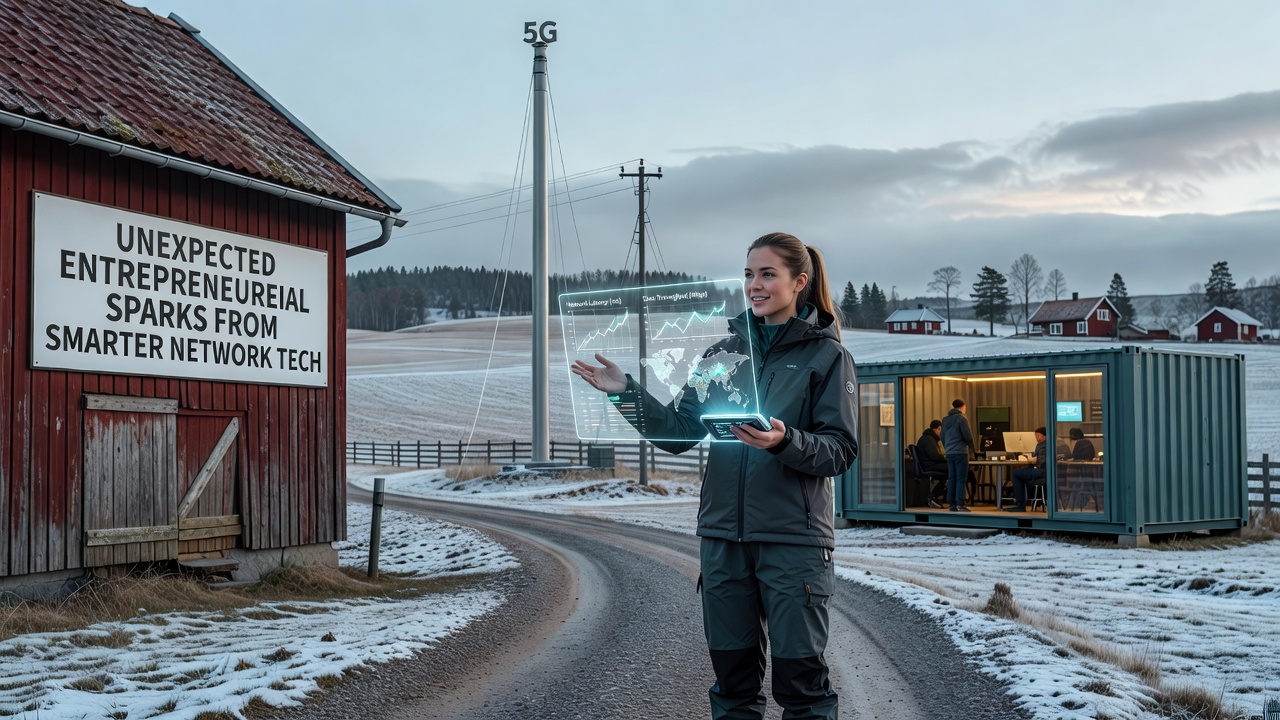
Unexpected Entrepreneurial Sparks from Smarter Network Tech in Rural Scandinavia
Advanced network technologies have rolled out across rural stretches of Norway, Sweden, and Finland over the past decade, and those deployments have created new pathways for business formation in areas once limited by slow or unreliable connections. Data from regional infrastructure reports show that average download speeds in these zones rose from under 10 Mbps in 2018 to more than 100 Mbps by late 2025, while latency dropped enough to support real-time applications such as remote equipment monitoring and cloud-based design tools. Researchers tracking business registrations note that the number of new enterprises in municipalities with upgraded networks grew by 18 percent between 2022 and 2025, with many ventures tied directly to the capabilities of smarter grids and edge computing nodes.
Network Upgrades and Their Reach
Operators in the Nordic region completed several large-scale fiber and 5G small-cell projects between 2023 and 2026, extending coverage to communities that previously relied on copper lines or satellite links. Government statistics compiled by the Nordic Council of Ministers indicate that more than 85 percent of households in targeted rural counties now have access to gigabit-capable service, and the remaining gaps are scheduled for completion by the end of 2027. These upgrades include software-defined networking features that let providers allocate bandwidth dynamically, which proves useful for seasonal industries like agriculture and tourism that experience sharp demand spikes. Observers note that the same infrastructure also supports Internet of Things sensors for weather, soil, and equipment data, turning isolated farms into sources of continuous information streams.
Sectors Seeing New Activity
Precision agriculture stands out as one area where smarter networks translate into concrete ventures. Companies in northern Sweden have launched platforms that combine drone imagery with real-time soil sensor feeds, allowing farmers to optimize fertilizer use and reduce runoff. One firm founded in 2024 now serves more than 300 holdings across Jämtland and Västerbotten counties after securing contracts based on data accuracy verified through university trials. In Finland, similar connectivity has enabled startups to develop remote forestry management services that track timber growth and harvest schedules without daily site visits. Figures released by the Finnish Forest Centre show that adoption of these services increased by 22 percent in connected rural districts during 2025.
Tourism operators have also shifted their models. Properties in Norway’s inland valleys now offer virtual-reality previews of hiking routes and fishing spots, a feature made possible by low-latency streaming. Booking platforms built on local servers handle peak summer traffic without the outages that once plagued smaller sites. Data collected by the Norwegian Tourism Board reveals that properties advertising these digital experiences recorded a 15 percent rise in advance reservations compared with those using only traditional channels.

Support Structures and November 2026 Milestones
Local innovation hubs have appeared alongside the physical infrastructure. Municipalities in Sweden’s Dalarna region opened shared workspaces in 2024 that provide high-speed access and mentoring programs, and similar facilities opened in Finnish Lapland the following year. These centers report steady occupancy from founders who previously commuted to larger cities or worked from home with unreliable links. In November 2026, a joint Nordic pilot project is set to activate additional edge computing nodes in three counties, giving startups access to low-latency processing for machine-learning tasks without routing data through distant urban data centers. Project documentation indicates that the nodes will initially support up to 50 early-stage companies focused on logistics optimization and renewable-energy monitoring.
Academic partnerships supply additional momentum. A multi-year study coordinated by the University of Oslo and Lund University tracks how network performance correlates with startup survival rates, and preliminary findings presented in 2025 showed that ventures using cloud services experienced 12 percent higher revenue growth in the first two years compared with those limited to on-premise systems. Funding programs from the European Regional Development Fund have directed grants toward rural tech pilots, with allocation data showing that 35 percent of awards in the 2024-2026 cycle went to projects in sparsely populated areas.
Challenges and Ongoing Adjustments
Skill gaps remain a constraint even where connectivity has improved. Vocational schools in rural counties have expanded courses in network maintenance and data analytics, yet enrollment figures from 2025 indicate that demand still outpaces supply in some districts. Regional authorities have responded by offering online certification programs that leverage the same upgraded networks, allowing residents to train without relocating. Trade associations representing small businesses report that mentoring networks have formed across county lines, sharing best practices on scaling digital services while complying with varying national regulations on data storage and privacy.
Conclusion
Network technology continues to reshape the economic landscape of rural Scandinavia by lowering barriers to market entry and enabling data-driven operations across traditional industries. Ongoing deployments scheduled through 2027, combined with targeted training and funding mechanisms, point toward sustained growth in new enterprise formation. Statistics compiled by national statistical agencies and regional development bodies show consistent upward trends in business registrations and revenue in connected areas, suggesting that the pattern observed through 2026 will extend as coverage expands and applications mature.